Retail example
Marks & Spencer (M&S)
~£300m expected impact on operating profit.
~30% of FY25 operating profit.


Adopted by Treasury, Operations, and CISO teams
THE COST OF INACTION
When core systems go down, the clock starts immediately: on payroll, supplier payments, production, regulatory obligations, client commitments. Every day without execution is a day your counterparties start looking for alternatives.
Recent incidents show what "a few weeks of disruption" actually means in practice: hundreds of millions in losses. These are not edge cases. For any large enterprise, a 4-week operational freeze represents 5 to 30% of annual operating profit; before reputational damage, regulatory scrutiny, and the client relationships that don't come back.
And yet, most large enterprises still rely on the same approach: documented continuity plans, built for audit, not for execution. Plans that assume systems will be available. Plans that have never been tested under real conditions.
Retail example
Marks & Spencer (M&S)
~£300m expected impact on operating profit.
~30% of FY25 operating profit.
Manufacturing example
Jaguar Land Rover (JLR)
~£196m declared exceptional direct costs.
~8.0% of FY25 operating profit.
Operational resilience is not an IT problem. It is a business survival problem and it belongs on the executive agenda, not in a risk register.
THE FRAMEWORK
A Minimum Viable Company is the minimal set of critical processes and data that an organization must keep executable to sustain its essential operations through a major disruption. It is an execution posture, not a documentation exercise.
WHERE TO START
In crisis, cash is the lifeblood of the enterprise. Treasury is the recommended entry point: process-intensive, data-driven, and naturally connected to procurement, HR, and finance.
A company that can pay its critical suppliers, its employees, and service its debt during a crisis has preserved its most fundamental operating capability.
Ownership
Head of Operations (COO)
The executive sponsor. Validates the list of vital activities and empowers the organization to build and maintain them. Chairs the annual readiness review. Resilience starts and ends on their agenda as owner of company operations.
Head of Business Units (starting with Treasury)
The process experts. They know what needs to run, in what order, what data is required, and under what regulatory and compliance constraints. Treasury is the natural entry point: critical payments are universally understood, immediately quantifiable, and directly connected to survival.

Head of Resilience (CISO)
The governance layer. Signs off on the independent execution architecture, guarantees confidentiality, integrity, and availability and owns the audit trail. Turns executive intent into verifiable and secure capability.
IN PRACTICE
Trusted by leading enterprises to keep critical execution going when the environment fails.
 Operational in 1 month
Context: Critical treasury and payroll continuity during crisis conditions.
What stayed executable: Treasury workflows and HR data validation with confidential collaboration.
Result: Payroll execution remained controlled and auditable under disruption.
Operational in 2 weeks
Context: During a major disruption.
What stayed executable: Treasury and HR critical workflows.
Result: First critical process live in two weeks.
Operational in 3 months
Context: High-threat operating environment.
What stayed executable: Treasury and critical operations continuity.
Result: Continuity maintained under cyber pressure.
Operational in 1 month
Context: Resilience modernization under cyber risk pressure.
What stayed executable: Recovery coordination and continuity workflows.
Result: Faster recovery readiness and stronger continuity posture.
SECURITY & COMPLIANCE
When your organization executes critical processes during a crisis, the data involved is at its most sensitive and your systems are at their most exposed. Astran is architected for exactly that moment.
EXECUTIVE Q&A
Ensuring continuity of the core business is an executive committee responsibility, and resilience must become operational fast. The question is no longer if disruption happens, but when it happens.
Execution breaks first. Within hours, teams lose access to the tools, approvals, and data they need to operate. Payments stop. Supplier commitments are missed. Regulatory deadlines pass. IT recovery takes weeks, business damage accumulates from day one, before any system is restored.
BCP plans describe what should happen. They do not make it happen when the infrastructure that runs them is unavailable. Cloud uptime is not process resilience: your SaaS can be online while identity, SSO, and approval workflows are completely down. Most continuity plans were built for audit, not for execution under real crisis conditions. The gap between the plan and what actually runs is where companies lose hundreds of millions.
DORA, NIS2, ISO 22301, and the UK PRA/FCA Operational Resilience Policy to just name a few, all explicitly require that critical processes remain executable during disruption. Documented plans no longer satisfy regulators. The standard has shifted from "we have a plan" to "we can prove it runs." Non-compliance is now a board-level exposure, not a technical checkbox.
Because the financial meter starts on day one of a disruption. M&S lost ~£300M, approximately 30% of FY25 operating profit. Jaguar Land Rover declared £196M in direct exceptional costs. Government agreed to guarantee up to £1.5 billion in commercial borrowing to provide liquidity to JLR & its suppliers and protect jobs! These are not tail risks: they are recent, documented, and directly attributable to the inability to execute critical operations during a crisis. A risk register entry does not stop a payment chain from collapsing.
The threat surface changed. Cyberattacks now target identity and access layers, not just data. IT interdependencies have multiplied with SaaS adoption. Other risks joined the game as geo-political desicions. And regulators have moved from principles to enforceable standards. Organizations that built their resilience posture five years ago are managing today's risks with yesterday's architecture. The question is not whether to revisit, it is whether to do it before or after an incident.
A documented plan tells people that we migh need them in a crisis, but not what to do. An executable process gives them the steps, the data, the approvals, and the access to actually do it; independent of whether primary systems are available. The difference only becomes visible during a crisis. By then, it is too late to close the gap.
Virtually every large enterprise starts with Finance/Treasury: critical payments, payroll, and supplier settlements. Cash obligations are non-negotiable, universally understood, and directly connected to survival. Once the first processes are operational, the same model extends to any vital activity as procurement, supply chain, HR, customer commitments; following the same build-once, run-independently logic.
A simple, well-documented process can be operational on Astran in under two weeks while a complex undocumented process may take up to three to three months. The constraint is rarely Astran. It is the quality of crisis process documentation/knowledge on the client side.
The core work requires two to three people: a process owner from the business unit, an IT contact for data access and integration, and a project lead. There is no infrastructure to deploy and no long onboarding cycle. The build phase is additive; it does not touch primary systems and does not disrupt daily operations. Most of our clients describe it as the least disruptive resilience initiative they have ever run.
The project always requires three functions to align: the COO or executive sponsor to validate vital activities and fund the initiative, the Head of Treasury or relevant Business Unit to own the processes (calling when needed SMEs from their teams), and the CISO to validate the independent architecture and sign off on security. Experience shows that Treasury is the fastest entry point to build consensus; the business case is immediate, the perimeter is clear, and the value is visible within weeks of go-live.
BCP tools produce documentation. DR and backup platforms restore infrastructure. Neither makes your business processes executable during the window between incident and recovery, which is precisely where the financial and operational damage happens. Astran is the only platform that combines dynamic process execution, independent data continuity, and post-quantum data confidentiality in a single service. No equivalent exists on the market today: each of these three capabilities is available elsewhere in isolation. The combination is not.
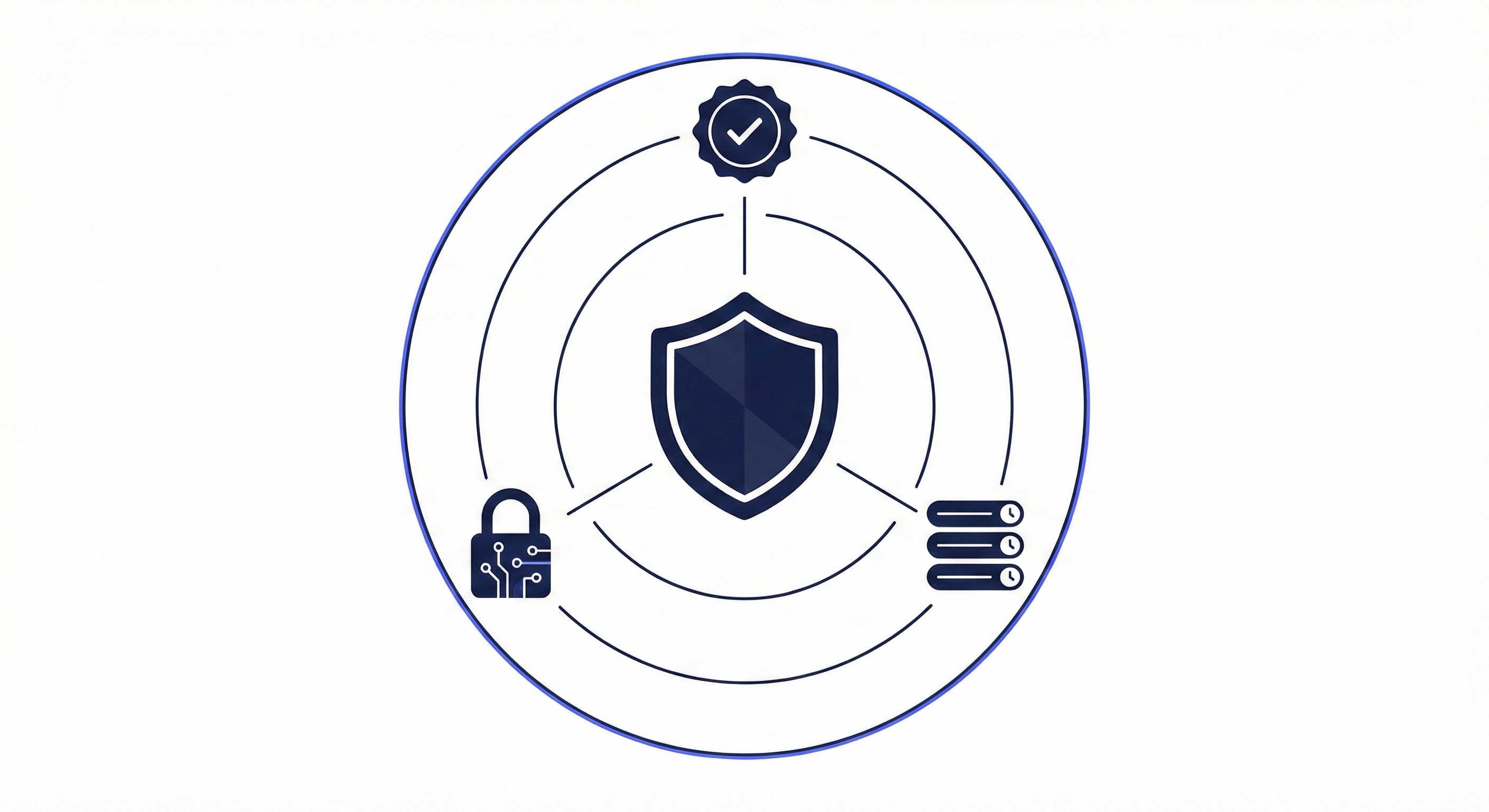
Astran is SOC 2 Type II certified with regular penetration testing. The platform's cryptographic architecture is patented and post-quantum secure. Every action executed on the platform is immutable, versioned, and traceable, producing a complete audit trail that satisfies both internal audit and external regulatory scrutiny. Procurement teams receive a standard security package covering assurance and architecture documentation.